Jewish History and Ongoing Conflicts
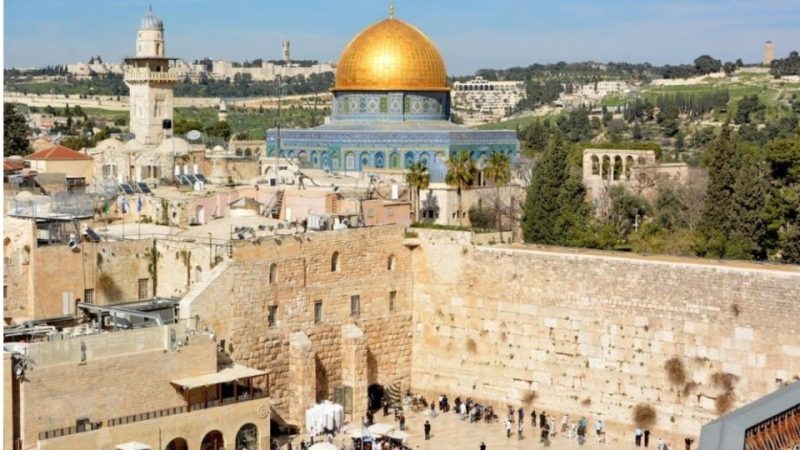
This article provides an overview of Jewish history in Israel, from ancient times to their return in modern history. It then outlines the ongoing conflicts between Israel and the Palestinians.
Biblical Times: Roots in the Ancient Land
Ancestral Homeland. Jewish history in the region began around 1200 BC. The Israelites established tribes and eventually kingdoms in the land, then known as Canaan, Israel, or Judah.
Kingdoms & Temples. Under leaders like King David and King Solomon, Jerusalem became the spiritual and political capital. King Solomon built the First Temple in Jerusalem around the 10th century BC, making it the central site of Jewish worship.
Invasions and Survival. Over the centuries, the land was conquered by major empires (Assyrians, Babylonians, and Romans). Though the Babylonians destroyed the First Temple in 586 BC, Jews rebuilt it, continuing to live in the land for centuries despite foreign rule.
The Diaspora: Dispersion Across the World
Roman Destruction. In 70 AD, after a major Jewish revolt, Roman forces destroyed Jerusalem and the Second Temple. The Romans eventually drove most of the Jewish population out of the land and renamed the province Syria Palaestina.
Scattered Communities. This forced exile began the Diaspora—a Greek word meaning “dispersion.” For nearly 2,000 years, Jewish communities lived as minorities across Europe, the Middle East, North Africa, and later the Americas.
Preserving Identity. Despite living thousands of miles away, Jewish people maintained their culture, religion, and connection to the land through daily prayers, traditions, and hopes of returning to Jerusalem.
The Gathering Back to Israel
The Rise of Zionism. In the late 1800s, facing widespread anti-Semitism and violence in Europe, a political movement called Zionism emerged. It aimed to re-establish a legal, safe homeland for Jewish people in their ancestral land.
Waves of Immigration. Starting in the 1880s, waves of Jewish immigrants began purchasing land, draining swamps, and building agricultural settlements, towns, and cities like Tel Aviv.
Holocaust. During World War II (1933–1945), the Nazi regime led by Adolf Hitler carried out a systematic, state-sponsored genocide that murdered six million Jewish people—two-thirds of Europe’s Jewish population.
The 1948 War & Israeli Statehood. The United Nations voted to divide the land into separate Jewish and Arab states in 1947. Jewish leaders accepted the plan, but Arab leaders rejected it, viewing it as unjust to the local Arab majority. War broke out and in 1948, the State of Israel was officially established, welcoming millions of Jewish refugees and bringing the global Jewish community back together in their historic homeland.
The Conflict Between Israel and the Palestinians
Two Groups, One Land. Arab Palestinians had been living on the land over many centuries. With the establishment of the State of Israel in 1948, about 700,000 Palestinians were displaced or fled from their homes—an event Palestinians refer to as the Nakba (”Catastrophe”). The majority moved into the West Bank and Gaza Strip, while others settled in neighboring Arab states (Jordan, Lebanon, and Syria).
1967 & Occupation. During the 1967 Six-Day War, Israel captured the West Bank, East Jerusalem, and the Gaza Strip. Since then, millions of Palestinians have lived under varying degrees of Israeli military control, while Israeli citizens began moving into these areas to build settlements.
Unresolved Issues. Peace negotiations remain stalled over four primary issues: agreeing on official borders, deciding who controls Jerusalem, resolving the status of Israeli settlements in the West Bank, and addressing the right of return for Palestinian refugees.
Palestinian Government and Internal Division
Fatah (The Secular Movement). Founded in 1959, Fatah became the primary secular, political faction of the Palestinian national movement. In the 1990s, under the Palestine Liberation Organization (PLO), Fatah recognized Israel’s right to exist and agreed to pursue a diplomatic two-state solution.
First Intifada (1987). Meaning “shaking off” in Arabic, the Intifada was a widespread popular uprising by Palestinians against Israeli military rule. Driven by decades of frustration, it began as mass civil disobedience, strikes, and protests.
Oslo Accords (1993 & 1995). Signed between Israel and the PLO, these agreements established the Palestinian Authority (PA)—led largely by Fatah—as an interim governing body with limited self-rule over pockets of the West Bank and Gaza. Intended as a steppingstone to a final peace treaty, the process stalled due to mistrust, political violence, settlement expansion, and leadership changes.
Hamas (The Religious Militants). Formed in 1987 as an Islamist movement originating from the Muslim Brotherhood, Hamas rejected peace treaties with Israel and advocated armed resistance to establish an Islamic state. Hamas gained grassroots popularity by providing social services, schools, and charities while attacking Israeli targets.
The 2005 Gaza Withdrawal & 2006/2007 Split. Israel unilaterally withdrew its military and settlements from Gaza in 2005. Frustrated by PA corruption and stalled statehood negotiations, Palestinian voters gave Hamas a majority in the 2006 legislative elections. Tensions between Fatah and Hamas erupted into a brief civil war in June 2007, resulting in Hamas seizing total internal control of Gaza, while Fatah retained administration of PA pockets in the West Bank. Israel and Egypt subsequently imposed a strict blockade on Gaza. No national Palestinian elections have been held since 2006.
2023 War in Gaza and Global Perspectives
October 7 Assault. On October 7, 2023, Hamas launched a massive surprise assault on Israel, firing thousands of rockets and breaching border barriers by land, sea, and air. Over 1,200 people were killed, primarily civilians, and about 250 were taken hostage. Some of the terrorists took photos and videos of their rape and murder of entire families. It was the deadliest day in Israel’s history since the Holocaust.
Military Campaign. Israel launched a major military campaign aimed at destroying Hamas and securing the hostages. Hamas embedded combatants and weapons within civilian infrastructures using children and women as human shields. Thus, when civilians were hurt or killed, some people condemned Israel, and Hamas was perceived to gain some level of legitimacy. The resulting air and ground operations caused widespread destruction in major Gaza cities, displacing nearly the entire population and causing tens of thousands of deaths, leading to a severe humanitarian crisis. The conflict also escalated regionally with Hezbollah in Lebanon and Houthi forces in Yemen.
Opposing Perspectives. Proponents of Israel’s actions argue that Israel is exercising its right to self-defense. They emphasize that Israel issues advance evacuation warnings to minimize civilian harm. Critics argue that the scale of destruction and high civilian death toll constituted disproportionate force or war crimes under international law.
Jews are the native people of the land of Israel and believe it is their ancestral homeland. They do not see Hamas as a liberation movement, but as a terrorist organization that stages attacks on Israel to remove the Jews from their ancestral homeland.
Modern-Day Palestinians and Statehood Debate
Diverse Perspectives. Palestinian society includes a wide range of political and social views. Many who support Hamas do so because they see it as the only active group who is resisting occupation, not because they necessarily share the religious doctrine. Many Palestinians favor diplomatic resolution, nonviolent resistance, or a two-state solution.
Demographics. The current population of about 14 million include the following:
- Arab Citizens of Israel (about 2 million) who have full Israeli citizenship, though often reporting social inequities.
- West Bank (about 3.2 million) who live under PA administrative pockets, with overall Israeli military control and expanding settlements.
- Gaza Strip (about 2.1 million) who are ruled internally by Hamas, subject to the Israeli-Egyptian blockade.
- East Jerusalem Residents (about 360,000) who hold permanent Israeli residency status.
- Refugee Diaspora (6+ million) across Jordan, Lebanon, Syria, and worldwide.
The Statehood Question. Debate continues over a two-state solution. Prime Minister Benjamin Netanyahu and his supporters contend that a fully sovereign Palestinian state would pose an unacceptable security risk and serve as a launchpad for attacks against Israel. Therefore, Israel would have to retain security control of the airspace and borders. Opponents argue that denying statehood prolongs military occupation and prevents long-term regional stability.
Key Slogans. The slogan “Free Palestine” calls for self-determination, civil rights, and an end to military occupation. Critics argue that when combined with phrases like “From the river to the sea,” it can imply the elimination of Israel as a Jewish state (from the Jordan River to the Mediterranean Sea).