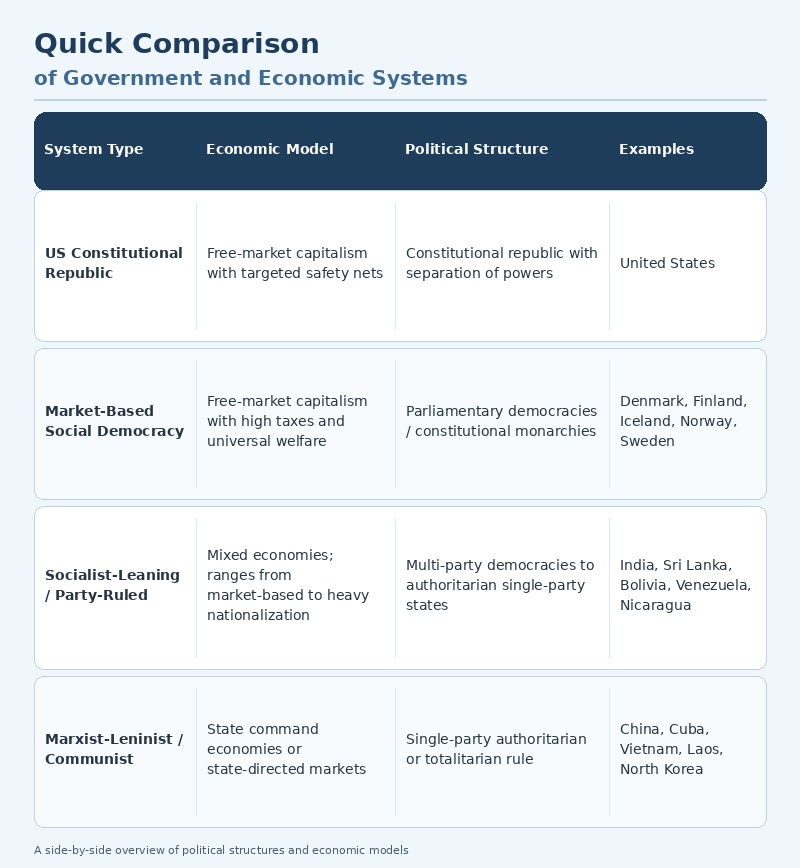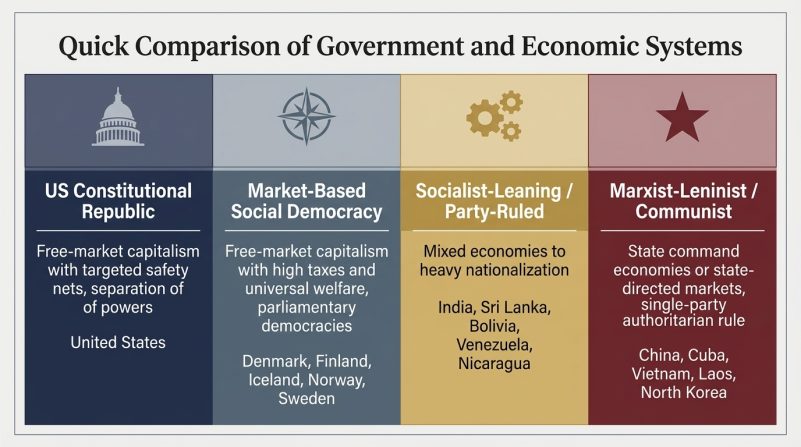
In political debates across the United States, labels like “socialist,” “communist,” and “capitalist” get thrown around constantly, and often inaccurately. Many people assume that countries like Sweden or Denmark are socialist, or that any government with strong social programs is socialist or moving toward communism.
Taking a closer look at how different systems of government actually work, from the US constitutional republic to the Nordic model, and all the way to full socialist and communist states, helps clarify what these terms really mean. When we understand the real differences, we can have a much more honest conversation about what works, what does not, and what fits with American values.
1. The US Constitutional Republic and Free-Market Capitalism
The United States is a constitutional federal republic built on a free-market capitalist economy. In this system:
- Individual Liberty and Private Property. Citizens have the right to own private property, start businesses, and keep the wealth they earn.
- Limited Government. Power is divided among the President, Congress, and the Supreme Court, with the US Constitution protecting individual rights from government overreach.
- Targeted Safety Nets. While the United States relies on free enterprise to create wealth, it also maintains targeted social programs, such as Social Security, Medicare, and food assistance, to help seniors, people with disabilities, and low-income families.
This model is designed to reward innovation, hard work, and personal ambition, giving individuals the freedom to rise as far as their talents and efforts can take them.
2. Market-Based Social Democracies (The Nordic Model)
One of the biggest misconceptions in modern politics is that the Nordic countries, Denmark, Finland, Iceland, Norway, and Sweden, are socialist. In reality, they are market-based social democracies, not socialist states.
- How They Are Governed. Finland and Iceland are parliamentary republics, while Denmark, Norway, and Sweden are parliamentary democracies under constitutional monarchies. All five hold free elections, protect private property, and rely on competitive, capitalist market economies to generate wealth.
- The Trade-Off. What sets the Nordic model apart is its heavy taxation and expansive universal welfare programs, including government-funded healthcare, higher education, and childcare. Supporters argue this system creates a safer, less stressful daily life for the average citizen. However, it achieves this by placing a much lower ceiling on individual financial upside, using steep taxes to limit the accumulation of extreme private wealth. In Denmark, for example, top income tax rates reach nearly 60%, alongside a 25% sales tax on almost everything people buy.
- Not Immune to Human Nature. Even in countries designed to discourage massive wealth concentration, billionaires still exist and human nature remains the same. Even in Sweden, a country famous for high taxes and wealth equality, Ingvar Kamprad (the late Swedish founder of IKEA) built a fortune estimated at $43-60 billion.
Calling the Nordic countries “socialist” misses the mark. Even if you disagree with their high taxes and big-government safety nets, it is important to call their system what it actually is: a high-tax, market-based social democracy.
3. Nations With Socialist Constitutional References or Governing Parties
Moving further along the political spectrum are countries that either write socialist principles into their constitutions or elect explicitly socialist parties to run the government, even while keeping parts of a market economy:
- Constitutional References. Several nations include socialist language in their founding documents. India and Sri Lanka both retain the word “socialist” in their constitutional preambles or official names while operating competitive market economies. Bangladesh, Nepal, Guyana, and Tanzania also include historic or democratic socialist principles in their constitutions. Meanwhile, Nicaragua explicitly defines itself as a revolutionary socialist state following constitutional overhauls, and Eritrea is ruled by a single party rooted in Marxist traditions that directs the economy.
- Governed by Socialist Parties. In Latin America, countries like Bolivia and Honduras have elected administrations or legislative majorities aligned with socialist wealth redistribution policies. Venezuela, governed by the United Socialist Party, went much further by nationalizing oil and major industries while pairing heavy state control with government welfare programs, a shift that led to severe economic collapse and political authoritarianism.
4. Marxist-Leninist and Communist States
At the far end of the spectrum are Marxist-Leninist and communist states, where a single ruling party holds total political power and the state controls the economy:
- Cuba. Maintains one of the closest systems to a classic socialist command economy, with heavy state control over property, pricing, and central planning.
- North Korea. Operates a totalitarian command economy governed by a socialist constitution and the state ideology of self-reliance, leaving virtually no room for private enterprise or individual freedom.
- China, Vietnam, and Laos. Each is governed by a single ruling communist party. While these nations have allowed controlled market reforms and private investment to spur economic growth, such as “Socialism with Chinese Characteristics” or Vietnam’s “socialist-oriented market economy,” the communist party retains strict authoritarian control over politics, core industries, and citizens’ daily lives.
Why Getting the Labels Right Matters
Understanding the differences among these systems is essential for protecting the US constitutional republic. A free-market economy with basic safety nets is not socialism (see “‘Socialism’ vs ‘Social Programs’“). A high-tax Nordic social democracy is not socialism either, though its heavy reliance on government redistribution runs counter to the American tradition of limited government and individual enterprise. True socialism and communism, by contrast, replace private ownership and constitutional checks and balances with centralized state power.
When we use accurate terms instead of political buzzwords, we can clearly see what sets the United States apart and why preserving individual liberty, private property, and constitutional government remains worth defending.